
Colorado homeowners installing solar in 2026 can expect to pay around $27,696 for a typical 6.8 kW system before incentives, with pricing averaging $4 per watt across the state. That upfront investment buys access to some of the nation’s most favorable solar economics: Colorado law mandates net metering at full retail rates, your property taxes won’t increase despite adding thousands in home value, and Xcel Energy customers can even earn ongoing payments through the Solar*Rewards program for excess generation.
The real question isn’t whether solar works in Colorado. Our high elevation delivers more intense sunlight per square foot than coastal states, and our dry climate means fewer cloudy days interrupting production. What matters is choosing the right system configuration for your roof orientation, energy usage patterns, and budget constraints.
This guide walks you through the evaluation process with 2026 pricing data, compares the three main system types available to Colorado homeowners, and offers specific recommendations based on common scenarios we see across the Front Range and mountain communities. We’ll also flag the costly mistakes that trip up first-time solar buyers, from undersizing arrays to missing utility deadlines for interconnection credits. By the end, you’ll know exactly what questions to ask installers and which system specifications matter most for Colorado’s unique combination of weather patterns and energy policies.
What Makes Colorado Ideal for Solar Energy
Colorado ranks among the most favorable states for solar energy adoption, offering homeowners a combination of natural advantages and supportive policies that make residential solar both practical and profitable.
The state receives approximately 300 days of sunshine annually, providing consistent solar radiation even during winter months. High elevation across much of Colorado actually enhances solar panel efficiency, cooler temperatures prevent the performance losses that affect panels in hotter climates. This means your system generates more electricity per panel than comparable installations in states with intense summer heat.
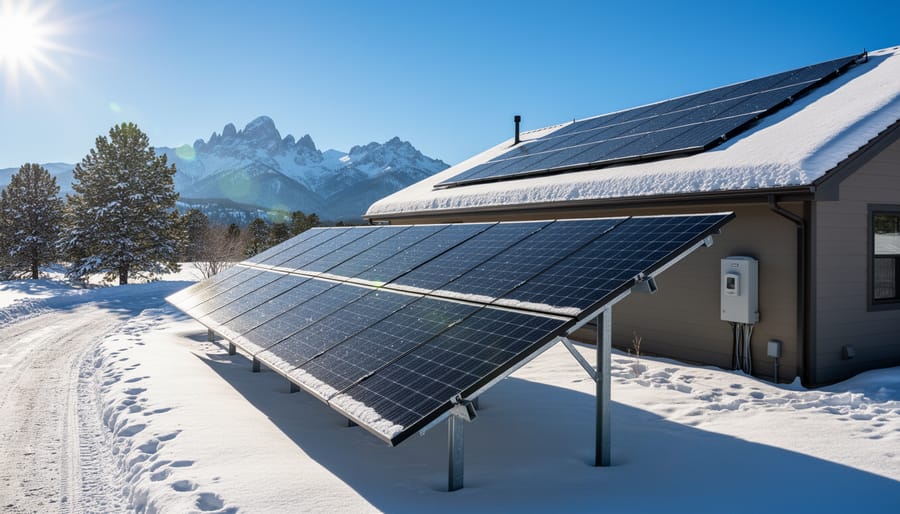
Colorado’s geography works in your favor too. The state’s relatively dry climate means fewer cloudy days interrupting generation, and snow typically slides off tilted panels or melts quickly under the strong sun. Even in mountain communities, the combination of clear skies and reflective snow cover can boost energy production during winter.
Beyond natural conditions, Colorado has built a legislative framework that actively supports solar adoption. State law requires utilities to offer net metering, which credits homeowners at the retail rate for excess solar energy sent back to the grid. This policy transforms your solar array into a two-way energy solution, you draw power when you need it and bank credits when you generate more than you use.
The state also exempts the added value of residential solar installations from property tax, protecting homeowners from increased assessments after installation. Combined with programs like Xcel Energy’s Solar*Rewards, which provides ongoing payments for excess generation, Colorado creates multiple revenue streams that accelerate your return on investment.
For homeowners weighing the solar decision, these factors mean your system will produce reliably year-round while state policies maximize your financial benefits. Colorado isn’t just suitable for solar, it’s structured to make it work exceptionally well.
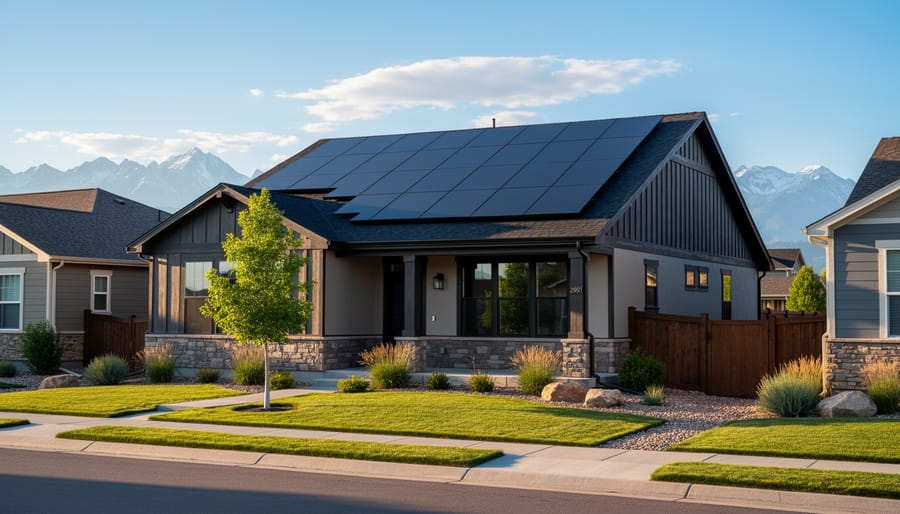
Key Factors When Choosing Solar for Your Colorado Home
Choosing the right solar system for your Colorado home requires evaluating several critical factors that will impact both your initial investment and long-term savings. Making informed decisions on these fronts ensures you get a system sized appropriately for your needs and positioned to deliver maximum value over its multi-decade service life.
Start by understanding your energy consumption patterns. A home energy audit provides precise data on your household’s electricity usage, revealing peak demand periods and identifying efficiency improvements that might reduce the system size you need. This baseline helps you avoid both undersizing (which leaves you buying grid power) and oversizing (which means paying for capacity you won’t use, even with net metering credits).
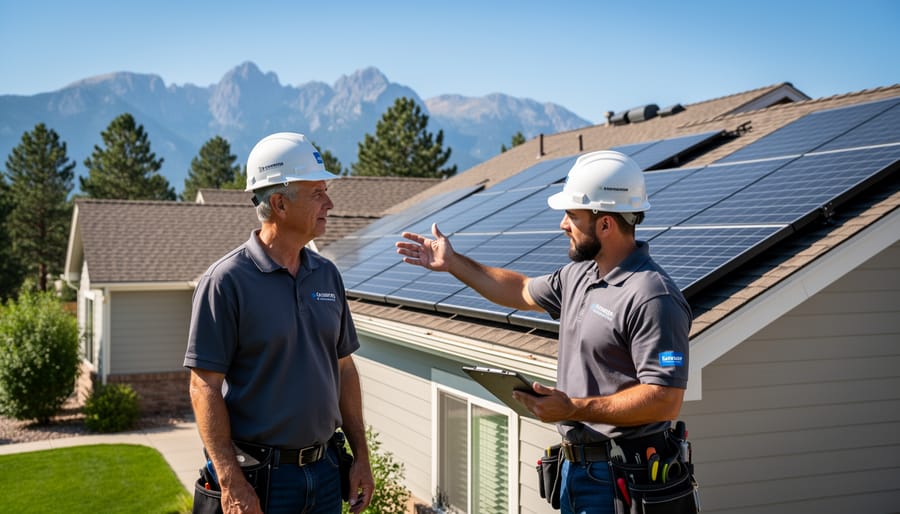
Your roof’s condition and characteristics play an equally important role. Solar arrays typically last 25 to 30 years, so installing panels on a roof that will need replacement in five years creates expensive complications. Beyond structural integrity, assess your roof’s orientation and pitch. South-facing roofs with 30 to 40-degree slopes capture the most sunlight in Colorado, though east and west orientations can still perform well. Shading from trees, chimneys, or neighboring structures significantly reduces output, so a professional site assessment is essential before committing.
Budget considerations extend beyond the sticker price. In Colorado, residential systems average $4 per watt, meaning a typical 6.8 kW array costs around $27,696 before incentives. Factor in Colorado’s property tax exemption for solar installations and net metering credits at retail rates, which directly offset your utility bills. Consider financing options carefully: cash purchases deliver the best lifetime returns, while solar loans spread costs over time, and leases or power purchase agreements require minimal upfront investment but transfer ownership benefits to third parties.
Key factors to evaluate when selecting your solar system:
- Annual household energy consumption and usage patterns
- Roof condition, age, orientation, and shading obstacles
- Available budget and preferred financing approach
- Appropriate system size based on consumption and roof space
- Installer certifications, local experience, and references
- Equipment warranties and performance guarantees
- Monitoring capabilities for tracking production and issues
Don’t overlook the solar panel lifespan when evaluating warranties and long-term value. Quality equipment backed by strong warranties protects your investment, while monitoring systems let you verify your panels are performing as expected and catch problems early. Colorado’s climate is generally favorable for solar, but choosing components rated for temperature extremes and occasional hail ensures durability across seasons.
Types of Solar Energy Solutions for Colorado Homes
Grid-Tied Solar Systems
Grid-tied systems are the most popular choice for Colorado homeowners, connecting your solar panels directly to the utility grid while taking full advantage of the state’s mandatory net metering policies. When your panels produce more electricity than you’re using, that excess flows back to the grid and you receive credits at the retail rate, essentially running your meter backward. This arrangement works seamlessly with utilities like Xcel Energy, which also offers the Solar*Rewards program that provides ongoing payments for the solar energy you generate.
The beauty of grid-tied systems is their simplicity and cost-effectiveness. You’re not paying for expensive battery storage, yet you still get full benefit from every kilowatt your panels produce. Colorado law requires all utilities to offer net metering, so those credits you earn during sunny days offset your electricity use at night or during cloudy periods. Xcel Energy customers get an additional benefit through the details of Solar*Rewards program, earning payments on top of the standard net metering credits.
Installing the best solar panels in a grid-tied configuration typically delivers the fastest payback period because you’re maximizing savings without the upfront cost of batteries while benefiting from Colorado’s strong incentive structure.
Solar Plus Battery Storage
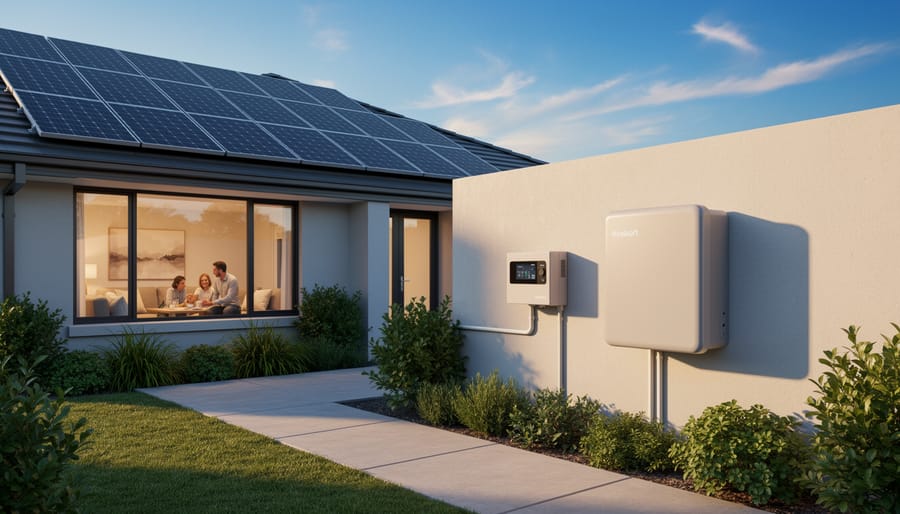
Solar plus battery storage systems pair traditional solar panels with lithium-ion batteries that store excess energy generated during the day. Instead of sending all surplus power back to the grid, these hybrid systems capture and hold that energy for use when the sun isn’t shining, during evenings, cloudy days, or power outages.
For Colorado homeowners, this investment makes the most sense if you experience frequent grid outages, face time-of-use electricity rates, or simply value energy security. While Colorado’s strong net metering policies mean grid-tied systems already credit you at retail rates for excess production, batteries provide backup power that standard systems can’t deliver. During winter storms or unexpected utility interruptions, your essential circuits stay powered.
The trade-off is cost. Adding battery storage typically increases your total system investment by $10,000 to $15,000, depending on capacity. You’re paying for independence and reliability rather than immediate financial returns. If your primary goal is maximizing savings through net metering, a standard grid-tied system delivers better economics. But if you need guaranteed power for medical equipment, home offices, or peace of mind during Colorado’s unpredictable weather, the added energy independence justifies the premium.
Off-Grid Solar Solutions
Off-grid solar systems represent the most comprehensive approach to energy independence, designed for Colorado homeowners who want complete self-sufficiency or live in remote areas where grid connection isn’t practical or affordable. Unlike grid-tied systems that rely on utility infrastructure, off-grid setups must generate and store all the electricity your home needs, year-round.
These systems require significantly more equipment than standard installations. You’ll need a larger solar array to account for Colorado’s shorter winter days, a substantial battery bank (typically 20-30 kWh or more), charge controllers to manage power flow, and an inverter system to convert DC power to usable AC electricity. A backup generator is often essential for extended periods of cloudy weather or higher-than-expected energy demands.
The upfront investment is considerably higher, often two to three times the cost of a comparable grid-tied system, because you’re building your own mini power plant. System sizing becomes critical: undersize it and you’ll face power shortages during winter months, but oversizing drives costs up unnecessarily.
Off-grid makes the most sense for mountain properties miles from the nearest utility connection, where bringing in power lines could cost $50,000 or more. For homes near existing infrastructure, the financial case weakens considerably, since you forfeit Colorado’s strong net metering benefits and ongoing utility credits. You’ll also need to manage your energy consumption more carefully and handle all system maintenance yourself.
Understanding Solar Costs and System Sizing in Colorado
Solar system costs in Colorado break down into two key components: the price per watt and your home’s total energy needs. The average price for residential solar sits at $4 per watt, which translates to specific investment figures once you know the right system size for your situation.
Most Colorado homes require a 6.8 kW system to offset typical household electricity consumption. At $4 per watt, this works out to $27,696 before applying any tax credits or incentives. That sticker price might feel steep, but Colorado’s incentive programs significantly reduce the actual out-of-pocket cost, a topic we cover in detail in the next section.
Calculating your specific system size starts with understanding your annual electricity consumption. Pull out a year’s worth of utility bills and find your total kilowatt-hours used. Divide that number by 1,400 (Colorado’s average annual sun hours per kilowatt of installed capacity) to estimate the system size you need. A household using 9,500 kWh annually would need roughly a 6.8 kW system to achieve full offset.
Several factors influence your final project cost beyond the base per-watt rate. Roof complexity matters, a simple south-facing roof costs less to install than one with multiple angles, skylights, or heavy shading. Your electrical panel might need upgrades to handle the solar input, adding $1,000-3,000 to the project. Geographic location within Colorado plays a role too, as labor costs vary between urban Denver and rural mountain communities.
System size also affects per-watt pricing. Larger systems benefit from economies of scale, sometimes dropping the per-watt cost by 10-15% compared to smaller installations. However, oversizing your system rarely makes financial sense in Colorado. Net metering credits excess production at retail rates, but you’re better off sizing the system to match your actual consumption rather than over-investing in capacity you won’t fully utilize.
Equipment quality creates price variation as well. Premium panels with higher efficiency ratings cost more per watt but generate more electricity from the same roof space, a worthwhile trade-off if your roof area is limited. The inverter type you choose (string inverters versus microinverters) impacts both upfront costs and long-term performance, with microinverters typically adding $0.30-0.50 per watt to the total.
Colorado Solar Incentives and Financial Benefits
Colorado homeowners have access to some of the most favorable solar incentives in the nation, making 2026 an excellent time to invest in residential solar. These financial benefits work together to significantly reduce your upfront costs and accelerate your return on investment, often cutting the effective price of a solar installation by 40% or more.
The federal Investment Tax Credit (ITC) remains the cornerstone incentive, allowing you to deduct 30% of your total solar installation cost from your federal taxes. For an average 6.8 kW system priced at $27,696, this credit alone saves you over $8,300. Unlike some states, Colorado doesn’t add additional state tax credits, but it compensates through other robust programs that provide ongoing value.
Colorado law mandates that all utilities offer net metering, and the terms are among the most generous you’ll find. When your solar panels generate more electricity than you use, that excess energy flows back to the grid and you receive credits at the full retail rate, not a reduced wholesale rate. This means every kilowatt-hour you export is worth the same as what you’d pay to buy electricity from your utility. For homeowners with correctly sized systems, these credits can zero out electric bills during sunny months and carry forward to cover usage during winter.
The state’s property tax exemption deserves particular attention because it protects you from a hidden cost that affects solar owners in many other states. When you install solar panels, they increase your home’s value, but Colorado exempts that added value from property tax assessments. You gain the benefit of a more valuable home without paying higher taxes year after year.
Xcel Energy customers have an additional advantage through the Colorado solar rebates available via the Solar*Rewards program. This program provides ongoing payments for the excess renewable energy your system produces, creating a revenue stream beyond the net metering credits. The specific payment rate varies based on program enrollment levels, but it represents genuine passive income from your solar investment.
When you stack these incentives together, the financial picture becomes compelling:
- Net metering credits at full retail electricity rates that can eliminate monthly bills
- Property tax exemption on the added home value from your solar installation
- 30% federal Investment Tax Credit reducing upfront costs by thousands
- Solar*Rewards payments for Xcel Energy customers generating additional income
- Typical payback periods of 8 to 12 years with 25-plus years of system life
These combined benefits mean that after your payback period, you’re generating essentially free electricity for another 15 years or more. The exact timeline depends on your system size, energy usage, and which utility you use, but the financial trajectory consistently favors solar investment. Most Colorado homeowners see their systems pay for themselves well before the equipment reaches even half its expected lifespan, then continue reaping savings for decades.
Our Recommendations for Colorado Homeowners
Best Approach for Cost-Conscious Homeowners
For homeowners watching their budget, a standard grid-tied system sized to match, not exceed, your actual energy consumption offers the smartest path to solar savings. Focus on systems in the 5 to 7 kW range, which typically cost between $20,000 and $28,000 before incentives (at Colorado’s average $4 per watt). This approach maximizes Colorado’s retail-rate net metering, which credits excess production at full value, while avoiding the premium cost of oversized arrays.
Skip battery storage initially; grid-tied systems deliver faster payback periods since you’re investing only in panels and inverters without the $10,000-plus battery expense. The property tax exemption on your solar installation’s added value keeps ongoing costs low, and you’ll still benefit from the federal tax credit on the full system price.
Start with a professional energy audit to right-size your system based on historical usage. Installing exactly what you need, rather than planning for future electric vehicles or expansions you may not pursue, keeps upfront costs lean while still slashing your utility bills from day one.
Ideal Solution for Energy Independence Seekers
If backup power during outages and reduced dependence on the grid rank high on your priority list, a solar plus battery storage system delivers the energy security you’re after. This configuration pairs solar panels with battery banks that store excess energy generated during the day, providing power when the sun isn’t shining or when grid service is interrupted.
For most Colorado homeowners seeking meaningful energy independence, a 6.8 kW solar array paired with 10-15 kWh of battery storage strikes the right balance. This capacity handles typical household loads during outages and stores enough energy to cover evening usage from daytime solar production. While the upfront investment runs higher than grid-tied systems, expect to add $8,000-$12,000 for quality battery storage, the peace of mind and grid independence often justify the additional cost.
Colorado’s retail-rate net metering still works in your favor with this setup, crediting any excess energy your batteries can’t store. You maintain full grid connection for extended cloudy periods while gaining the resilience to ride out power disruptions that are becoming more common during severe weather events.
Fastest ROI Configuration
For homeowners focused purely on financial returns, a strategically sized grid-tied system offers the fastest path to profitability. The key is matching your system capacity to your actual energy consumption rather than oversizing, which means investing only in panels that will generate electricity you’ll use or can credit through net metering at retail rates.
In Colorado, the optimal configuration typically falls between 5-7 kW for average homes, allowing you to capitalize fully on the federal tax credit (which applies to the entire system cost) while keeping your upfront investment lean. At $4 per watt, a 6 kW system runs approximately $24,000 before incentives, but after the federal credit and Colorado’s property tax exemption, your effective cost drops significantly while net metering ensures every kilowatt-hour you generate offsets your utility bill at full retail value.
Skip battery storage for now if ROI speed is your priority. While zero energy homes represent the ultimate in self-sufficiency, batteries add $10,000-$15,000 to project costs without accelerating payback unless you face frequent outages. Xcel Energy customers should also enroll in Solar*Rewards to monetize excess generation beyond your consumption, stacking ongoing payments on top of your utility savings for maximum financial benefit.
Common Mistakes to Avoid When Going Solar in Colorado
Making the wrong decisions during your solar journey can cost thousands of dollars and years of regret. Many Colorado homeowners rush into solar installations without proper planning, only to discover problems that could have been easily avoided with better guidance upfront.
One of the most expensive mistakes is skipping a thorough roof assessment before installation. If your roof needs repairs or replacement within the next 10-15 years, address those issues first. Removing and reinstalling solar panels later typically costs $2,000-$5,000, turning what should have been a simple roof repair into a major expense. A quality installer will evaluate your roof condition and flag potential problems, but you should also get an independent roofing inspection if your shingles are more than 15 years old.
Choosing an installer based solely on the lowest price quote is another common pitfall. The cheapest bid often comes from companies cutting corners on equipment quality, installation standards, or post-installation support. You’re making a 25-year investment in your home, prioritize experience, local reputation, proper licensing, and quality warranties over saving a few hundred dollars upfront. Ask for references from Colorado homeowners who’ve had their systems operating for at least two years.
Here are critical mistakes Colorado homeowners should avoid when going solar:
- Ignoring necessary roof repairs or replacement before panel installation
- Failing to compare at least three detailed quotes from licensed installers
- Oversizing your system beyond actual usage or undersizing it to save money upfront
- Not verifying installer credentials, insurance coverage, and local references
- Overlooking warranty details for panels, inverters, and installation workmanship
- Missing opportunities to stack incentives from federal, state, and utility programs
Many homeowners also make sizing errors in both directions. Oversizing your system sounds appealing but wastes money if you can’t use the excess production, even with net metering. Conversely, undersizing to hit a lower price point means you’ll keep paying utility bills unnecessarily. The right approach is matching your system capacity to your actual consumption patterns, accounting for any planned changes like adding an electric vehicle.
Don’t skip the fine print on contracts and warranties either. Panel warranties typically cover 25 years, but inverter warranties may only cover 10-12 years. Understand what’s covered, who handles warranty claims, and whether your installer will still be in business years from now to honor their workmanship guarantee.
Main Options Compared
Colorado homeowners choosing solar typically decide between three main configurations, each suited to different priorities and budgets.
Grid-tied systems represent the most affordable entry point at approximately $27,696 for a 6.8 kW installation before incentives. These systems work directly with your utility connection, sending excess energy back to the grid through Colorado’s retail-rate net metering. You’ll maximize savings through programs like Xcel Energy’s Solar*Rewards while keeping upfront costs lowest. The tradeoff: no power during grid outages.
Solar plus battery storage adds $10,000, $15,000 to your investment but delivers backup power during outages and greater energy independence. You’ll store excess daytime production for evening use rather than relying entirely on net metering credits. This option makes sense if you experience frequent outages or want to minimize grid dependence while still maintaining utility connection.
Off-grid systems offer complete energy independence but require the highest investment, typically 40-60% more than grid-tied installations due to larger battery banks and backup generators. You’ll need professional sizing to handle Colorado’s seasonal variation and cloudy periods. This configuration suits remote properties without utility access or homeowners committed to full self-sufficiency regardless of cost.
Most Colorado homeowners choose grid-tied systems, leveraging strong net metering policies and the property tax exemption to optimize returns.
Frequently Asked Questions
Colorado homeowners considering solar energy often have similar questions about how solar works in our state’s unique environment and regulatory landscape. Here are answers to the most common questions we hear from homeowners evaluating solar solutions.
How much can I save with solar in Colorado?
With an average system costing $27,696 before incentives and the combination of federal tax credits, net metering at retail rates, and programs like Xcel Energy’s Solar*Rewards, most Colorado homeowners see substantial long-term savings on their electricity bills. Your specific savings depend on your energy usage, system size, and utility rates, but many systems pay for themselves within 7-12 years while continuing to generate free power for 25+ years.
Do solar panels work well in Colorado winters?
Yes, solar panels actually perform efficiently in cold temperatures, and Colorado receives excellent sunlight year-round with over 300 days of sunshine annually. Snow typically melts quickly off tilted panels, and the combination of cold temperatures and bright sun can actually boost panel efficiency compared to hot summer conditions.
What happens to excess energy my system produces?
Colorado law requires utilities to offer net metering, which credits you at the retail rate for excess solar energy your system sends to the grid. These credits offset your usage during evenings and cloudy periods, and Xcel Energy customers can also participate in the Solar*Rewards program for additional ongoing payments.
How long does installation take?
Most residential solar installations in Colorado take 1-3 days once permits are approved and equipment arrives. The full process from signing a contract to system activation typically takes 6-12 weeks, with permitting and utility interconnection accounting for most of the timeline.
What maintenance do solar systems require?
Solar panels require minimal maintenance beyond occasional cleaning if dust or debris accumulates, though rain typically handles this naturally. An annual inspection to check connections and inverter performance is recommended, but most quality systems operate maintenance-free for decades.
Will solar increase my property taxes?
No, Colorado law specifically exempts the added value of residential solar installations from property tax assessments. You benefit from the increased home value without any corresponding increase in your annual property tax bill.
Beyond these common questions, homeowners often wonder about system warranties, roof compatibility, and financing options. Quality solar panels typically come with 25-year performance warranties, while inverters are usually covered for 10-15 years. Your roof should ideally have at least 15-20 years of remaining life before installation to avoid the cost of removing and reinstalling panels during a roof replacement. Financing options range from cash purchases to solar loans and leases, each with different implications for incentive eligibility and long-term savings.
Working with an experienced local installer means you’ll get answers specific to your home’s situation, your utility provider’s particular requirements, and the most current incentive programs available in Colorado. A professional assessment addresses your unique questions and helps you understand exactly what solar can deliver for your household.
Colorado’s combination of abundant sunshine, strong net metering policies, and valuable incentives makes solar energy one of the smartest investments you can make for your home. With systems averaging $4 per watt and the state’s requirement that utilities credit excess energy at retail rates, Colorado homeowners are positioned to see substantial long-term savings while contributing to a cleaner energy future. The property tax exemption on solar installations further enhances the financial appeal, protecting you from increased assessments despite adding significant value to your home.
Making the transition to solar isn’t just about buying panels. It’s about partnering with professionals who understand Colorado’s unique conditions, from our intense UV exposure to winter weather patterns that affect system design. Local expertise matters when sizing your system correctly, navigating utility interconnection requirements, and maximizing programs like Xcel Energy’s Solar*Rewards. At Denver Home Energy, we’ve helped countless Colorado homeowners design custom solar solutions that align with their energy goals and budgets, backed by quality workmanship you can trust for decades.
The path to energy independence starts with understanding what’s possible for your specific home. Schedule a professional assessment to evaluate your roof’s solar potential, calculate your optimal system size, and explore how Colorado’s incentives apply to your situation. You’ll get clear answers about costs, savings projections, and realistic timelines, without pressure or gimmicks. Your energy future is worth getting right from the start.