
Commercial building energy systems are maintained by a combination of in-house facility teams, contracted mechanical service providers, and specialized energy management companies, depending on the size and complexity of the property. Large office towers and industrial complexes typically employ dedicated facility engineers who handle day-to-day operations, while smaller commercial buildings often rely entirely on third-party HVAC contractors for both routine maintenance and emergency repairs.
The structure mirrors residential energy maintenance in many ways, but at a much larger scale. Where a homeowner might schedule annual furnace tune-ups, a commercial facility manager coordinates quarterly inspections of rooftop units, chillers, boilers, and building automation systems. Understanding this commercial framework offers valuable perspective for Colorado homeowners considering upgrades to their own properties.
Property management companies often act as the coordinator, hiring licensed contractors for specialized work like ductwork modification, control system programming, or energy audits. This layered approach ensures that complex systems receive the expert attention they require while keeping costs manageable. For buildings pursuing LEED certification or energy performance targets, commissioning agents and energy consultants join the team to verify that systems operate as designed.
The maintenance responsibility ultimately falls to whoever owns the building, but the actual hands-on work involves multiple skilled professionals working in concert to keep heating, cooling, and electrical systems running efficiently year-round.
The Main Players: Who’s Responsible for Commercial Energy Systems
In-House Facility Management Teams
Large commercial properties, office towers, hospitals, university campuses, shopping centers, typically employ dedicated facility management teams who work on-site full-time. These teams operate much like internal departments within the organization, handling everything from routine filter changes to complex system diagnostics.
The staff makeup usually includes HVAC technicians who handle heating and cooling equipment repairs, electrical specialists who manage power distribution and lighting systems, and controls technicians who maintain building automation networks. A facility manager coordinates this team, scheduling preventive maintenance, managing vendor relationships, and ensuring systems run efficiently while staying within budget.
This in-house model gives property owners direct control over response times and maintenance quality. When a chiller fails or an air handler malfunctions, the team is already on-site and familiar with every quirk of the building’s systems. Resources like powerengineeringpractice.com provide ongoing technical training for these professionals, helping them stay current with evolving equipment and efficiency standards.
The tradeoff is cost. Maintaining a full-time team with benefits, tools, and continuing education represents a significant fixed expense, which is why this approach typically makes sense only for properties exceeding 100,000 square feet or with particularly complex energy systems requiring constant attention.
Third-Party Energy Service Providers
Many commercial building owners choose to outsource energy system maintenance rather than staff full in-house teams. They contract with specialized energy service companies (ESCOs) or mechanical service contractors who handle everything from scheduled preventive maintenance to emergency HVAC repairs.
This arrangement works much like when Colorado homeowners hire a trusted HVAC contractor for annual furnace tune-ups or system replacements. The difference lies in scale and scope. Commercial service agreements typically cover multiple buildings, complex chiller systems, rooftop units serving entire floors, and sophisticated controls that require specialized diagnostic equipment.
Third-party providers bring several advantages. They maintain teams of certified technicians with diverse expertise across different manufacturers and system types. When a building’s cooling tower fails on a Sunday afternoon, these companies dispatch qualified personnel immediately, something smaller properties couldn’t afford to keep on standby.
Service contracts often include performance guarantees and energy savings targets. The provider might commit to maintaining certain efficiency levels or keeping energy costs within agreed parameters. If systems underperform, they’re contractually obligated to fix them, creating accountability that benefits property owners and ultimately the tenants who depend on comfortable, efficient spaces.
Building Automation and Remote Monitoring
Modern commercial buildings rely heavily on building management systems (BMS) to monitor and control energy use across entire facilities. These sophisticated platforms connect HVAC equipment, lighting controls, and other building systems into a unified network that facility teams can access remotely from anywhere. The technology continuously tracks performance metrics, temperature fluctuations, energy consumption patterns, equipment runtime, and flags anomalies before they become costly failures.
Remote monitoring gives commercial maintenance teams an enormous advantage over traditional reactive approaches. Instead of waiting for a tenant complaint about a malfunctioning air handler, the BMS alerts technicians to unusual compressor vibrations or declining airflow days or weeks in advance. This predictive capability reduces downtime and extends equipment life significantly.
While homeowners won’t install enterprise-grade BMS platforms, the same principle applies: smart thermostats, energy monitoring systems, and professional assessments provide similar early-warning benefits. Understanding your home’s baseline performance through tools like an energy audit cost comparison helps you catch inefficiencies before they escalate. Commercial buildings prove that data-driven maintenance beats guesswork every time.
What Commercial Energy Maintenance Actually Involves
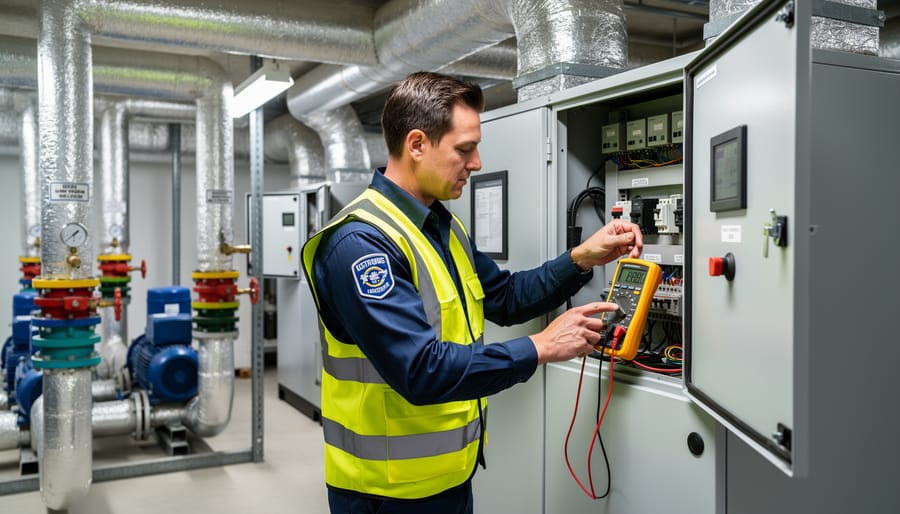
Commercial building energy maintenance spans multiple interconnected systems that far exceed the scope of typical residential work. Where a home might have a single HVAC unit and basic lighting, commercial buildings orchestrate complex networks of equipment that must operate continuously and efficiently.
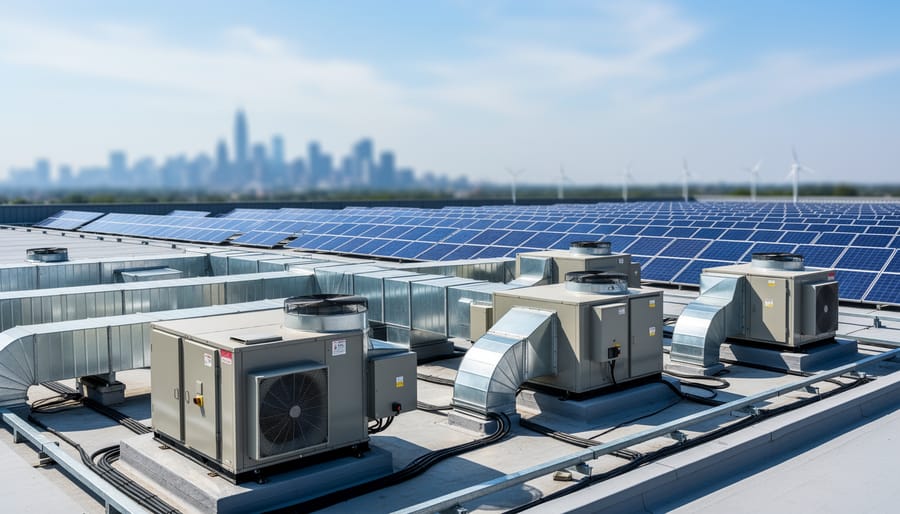
HVAC systems in commercial settings involve central chiller plants, multiple air handling units, variable air volume boxes, and sophisticated zoning controls spread across floors or wings. Maintenance teams monitor compressor performance, calibrate dampers, clean coils, replace filters in dozens of locations, and balance airflow to maintain comfort in spaces with wildly different thermal loads. A single commercial rooftop unit can weigh several tons and serve entire floors, requiring specialized lifts and multiple technicians for service work.
Lighting maintenance extends beyond bulb replacement. Commercial buildings use networked lighting controls, occupancy sensors, daylight harvesting systems, and scheduled dimming protocols. Technicians troubleshoot control panels, reprogram lighting scenes, verify sensor functionality, and upgrade fixtures to meet evolving energy codes. The sheer quantity, hundreds or thousands of fixtures, turns what seems simple into a logistical operation.
Building automation systems tie everything together through a central BMS that monitors temperatures, tracks energy use, schedules equipment operation, and flags anomalies. Maintaining these systems requires IT skills alongside mechanical knowledge. Technicians update software, troubleshoot communication networks, replace sensors, and fine-tune control sequences that optimize energy use while maintaining occupant comfort.
Renewable energy installations add another layer. Commercial solar arrays can cover entire rooftops with hundreds of panels, requiring periodic inspections, inverter maintenance, and performance monitoring. Understanding factors like solar panel lifespan helps maintenance teams plan for eventual component replacement in these large-scale systems. Wind turbines, if present, demand specialized mechanical and electrical expertise.
Electrical distribution systems in commercial buildings include transformers, switchgear, backup generators, and complex power monitoring equipment. Regular thermographic scans detect hot spots, preventive testing identifies failing components before outages occur, and load balancing ensures efficient distribution.
The scale multiplies everything. A residential HVAC system might use one air filter; a commercial building uses hundreds. A home has one thermostat; an office tower has sophisticated controls managing dozens of zones. Maintenance isn’t just more frequent, it requires coordinated scheduling to avoid disrupting occupants, detailed record-keeping to track thousands of components, and inventory management for parts across multiple systems. This complexity explains why commercial maintenance demands dedicated teams rather than the occasional service call that handles residential needs.
Required Certifications and Expertise
Commercial energy maintenance demands a significantly higher level of technical expertise than residential work, and the certifications required reflect that complexity. Professionals maintaining commercial buildings must hold multiple credentials that residential technicians rarely need.
At the foundation is the EPA Section 608 technician certification which commercial HVAC specialists need at the Universal level to handle high-pressure refrigerant systems found in commercial chillers and rooftop units. This goes beyond the Type I or II certifications common in residential work. Many commercial systems use refrigerants in quantities and pressures that residential technicians never encounter.
Electrical licensing represents another major distinction. Commercial energy maintenance staff typically hold journeyman or master electrician licenses because they work with three-phase power, high-voltage distribution systems, and complex lighting controls. Residential electricians, while skilled, usually deal with simpler 120/240V single-phase systems.
Building Management System (BMS) training adds another layer of specialized knowledge. Commercial technicians often need certifications from major control manufacturers, think Trane, Johnson Controls, or Honeywell, to program and troubleshoot the sophisticated automation systems that govern commercial energy use. These platforms integrate HVAC, lighting, and sometimes even renewable energy components like rooftop solar arrays that might qualify for commercial incentives similar to residential programs like Colorado’s solar rebate.
Manufacturer-specific certifications round out the requirements. Commercial-grade equipment manufacturers require specialized training before technicians can service warranty-covered equipment. A tech might need separate credentials for variable refrigerant flow systems, commercial boilers, or advanced air handling units.
The cumulative effect is clear: commercial energy maintenance personnel invest years building expertise that far exceeds typical residential requirements. For homeowners, this underscores why choosing properly certified professionals matters, even for residential systems that increasingly incorporate commercial-grade components.
Lessons Homeowners Can Take from Commercial Maintenance
While commercial buildings operate at a different scale, their maintenance strategies offer valuable lessons for Colorado homeowners looking to maximize energy efficiency and system longevity. The systematic approach that keeps office towers and shopping centers running efficiently can be scaled down and adapted to residential properties with significant benefits.
The most impactful practices you can borrow from commercial energy management include:
- Scheduled preventive maintenance rather than reactive repairs. Commercial facilities don’t wait for systems to fail, they follow manufacturer-recommended service intervals for HVAC tune-ups, filter changes, and equipment inspections. Homeowners can adopt this same approach by scheduling annual furnace and air conditioner maintenance before each season, preventing costly breakdowns and maintaining peak efficiency.
- Energy performance tracking to identify waste and opportunities. Commercial buildings use sophisticated monitoring, but homeowners can achieve similar insights through a home energy audit that reveals where your house loses energy and which upgrades deliver the best return on investment.
- Qualified professional service instead of the cheapest available option. Commercial property managers prioritize technicians with proper certifications and manufacturer training because cutting corners leads to higher long-term costs. The same principle applies to your home, investing in experienced, licensed professionals protects your equipment investment and ensures work meets Colorado building codes.
- System upgrades based on performance data rather than guesswork. Commercial facilities analyze energy usage patterns before making equipment decisions. Homeowners should request load calculations and efficiency modeling before replacing major systems, ensuring new equipment is properly sized and optimized for Colorado’s climate.
Colorado’s temperature swings and high-altitude conditions place unique demands on home energy systems, making these practices especially relevant. A proactive maintenance schedule, for instance, helps your furnace handle subzero nights and ensures your air conditioner can manage summer heat without straining.
Denver Home Energy applies these commercial-grade principles to residential service, combining systematic preventive care with the personalized attention your home deserves. Rather than treating energy efficiency as a one-time upgrade, the commercial model shows the value of ongoing optimization, an approach that reduces utility bills, extends equipment life, and improves home comfort year-round.
Common Questions About Commercial vs. Residential Energy Maintenance
Common Questions About Commercial vs. Residential Energy Maintenance
Understanding the differences between commercial and residential energy maintenance helps homeowners set realistic expectations for their own systems and recognize when they need specialized help.
How often do commercial systems need maintenance compared to residential systems?
Commercial systems typically require monthly or quarterly maintenance visits due to their constant operation and higher loads, while residential systems generally need service twice yearly. The heavier use patterns in commercial buildings accelerate wear and demand more frequent attention to maintain efficiency.
Can a residential HVAC contractor work on commercial systems?
Most residential contractors lack the certifications, equipment, and experience for commercial work, which involves larger capacity systems, complex controls, and different safety requirements. Commercial maintenance demands specialized training in building automation systems and industrial-grade equipment that residential technicians don’t typically encounter.
Why do large commercial buildings employ full-time energy management staff?
The scale and complexity of commercial systems justify dedicated personnel because even small efficiency improvements generate substantial cost savings across hundreds of thousands of square feet. A full-time engineer can continuously optimize performance, respond immediately to issues, and prevent costly downtime that would impact dozens or hundreds of occupants.
What’s the cost difference between commercial and residential energy maintenance?
Commercial maintenance contracts run thousands to tens of thousands annually depending on building size, while residential service agreements typically cost a few hundred dollars per year. The difference reflects not just system size but also the need for 24/7 availability, specialized expertise, and more frequent service intervals in commercial settings.
These distinctions highlight why homeowners benefit from working with contractors who understand residential-scale systems and can provide appropriately scaled solutions. You don’t need the elaborate infrastructure of a commercial building, but you can adopt the same preventive mindset and commitment to qualified service. Colorado homeowners who prioritize regular professional maintenance and energy monitoring see similar benefits to commercial properties: lower utility bills, fewer emergency repairs, and systems that perform reliably for their full lifespan.