
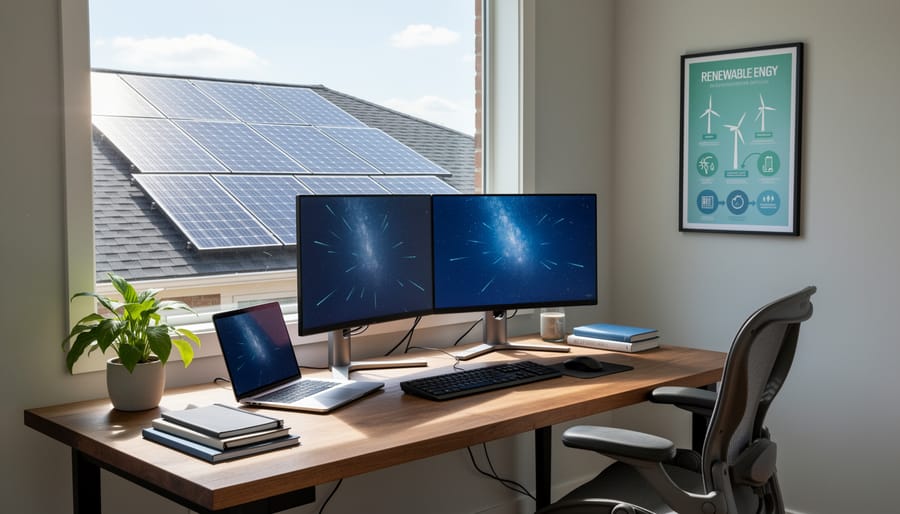
Calculate your home office power consumption by tracking your computer, monitors, router, and any additional equipment you run for extended periods. Most gaming setups draw between 300-800 watts per hour, which translates to roughly 3-8 kWh daily if you’re online consistently. Whether you’re working remotely, exploring a Live Dealer Casino platform, or streaming content, understanding your baseline usage helps you size your solar system appropriately for Colorado’s unique climate conditions.
Design your solar array with battery backup to ensure uninterrupted power during peak usage hours. Colorado receives approximately 300 days of sunshine annually, making it ideal for solar energy production, but evening and cloudy-day usage requires adequate storage capacity. A typical 5-8 kWh battery system paired with 3-4 kW of solar panels provides reliable power for home office operations while reducing your grid dependence by 60-80%.
Position your solar panels to maximize Colorado’s high-altitude sun exposure, which delivers 20% more solar radiation than sea-level locations. South-facing roof installations angled between 30-40 degrees capture optimal energy year-round, while ground-mounted systems offer flexibility for properties with shading issues or unsuitable roof orientations.
Integrate your solar system with your existing electrical setup through net metering programs available across Colorado, allowing you to bank excess daytime production for nighttime use. This approach eliminates concerns about power interruptions during extended online sessions while reducing monthly utility bills by $80-150 on average, creating long-term cost savings that offset your initial solar investment within 7-10 years.
Why Your Home Office and Online Activities Are Draining Your Wallet
If you’re spending hours each day working from home or enjoying internet-based entertainment, your energy bills are probably reflecting those habits more than you realize. Modern home office setups and extended online activities consume significantly more power than most Colorado homeowners expect.
Let’s break down what’s really happening with your energy usage. A typical desktop computer draws between 200-500 watts per hour, while even energy-efficient laptops use 50-100 watts. Add in your monitor (another 30-60 watts), your high-speed router running 24/7 (around 10-20 watts), and any external hard drives or peripherals, and you’re looking at substantial continuous power draw. If you’re running this setup for 8-12 hours daily, that’s easily 2-6 kilowatt-hours per day just for your computer equipment.
But here’s what many homeowners overlook: the hidden costs of climate control. Keeping your home office comfortable year-round means additional heating in Colorado’s cold winters and cooling during those warm summer afternoons. Computer equipment generates heat, which means your air conditioning works harder during warmer months. This can add another 1-3 kilowatt-hours daily to your energy consumption.
For the average Colorado homeowner, running a home office setup for extended periods translates to roughly $30-75 in additional monthly electricity costs, depending on your equipment and usage patterns. That’s $360-900 annually just to power your workspace and online activities. When you factor in Colorado’s variable electricity rates and seasonal price fluctuations, these costs can climb even higher during peak demand periods.
The good news? There’s a sustainable solution that puts you back in control of these expenses.
| Equipment | Typical Wattage | Hours Used Daily | Daily kWh |
|---|---|---|---|
| Desktop Computer | 200W | 8 | 1.6 |
| Laptop | 50W | 8 | 0.4 |
| Monitor (two screens) | 80W | 8 | 0.64 |
| Router | 10W | 24 | 0.24 |
| Printer | 50W | 2 | 0.1 |
| Office Lighting | 60W | 8 | 0.48 |
How Solar Energy Works for Your Home Office Setup
Understanding Your Energy Needs
Before investing in solar panels for your home office setup, you’ll need to calculate your actual power consumption. Start by checking the wattage labels on your essential equipment. A typical desktop computer draws between 200-500 watts, while laptops use just 50-100 watts. Add your monitor at 20-60 watts, router and modem combined at roughly 10-20 watts, and you’re looking at a baseline of 280-680 watts during active use.
Don’t forget climate control, which significantly impacts energy costs in Colorado’s varying seasons. A window AC unit can pull 500-1,500 watts, while efficient heating systems may require even more. For a typical home office running 8-10 hours daily, expect around 5-8 kilowatt-hours of consumption.
Here’s a practical example: If you’re running a mid-range desktop (300W), two monitors (80W), networking equipment (15W), and seasonal climate control (averaging 400W), you’re consuming roughly 795 watts per hour. Multiply by your daily usage hours to determine your solar system requirements. This calculation ensures your solar investment matches your actual needs, maximizing both energy efficiency and cost savings while maintaining reliable power for uninterrupted work.
Solar Panel Sizing for Reliable Power
Determining the right solar system size starts with understanding your power needs. For a reliable home office setup, calculate your daily energy consumption by adding up the wattage of all essential equipment—computers, monitors, routers, and any additional devices you run regularly. A typical home office draws between 300-800 watts during active use.
Colorado’s climate offers excellent solar potential, with approximately 300 sunny days annually. However, our high-altitude location and seasonal variations require thoughtful planning. During winter months, you’ll experience shorter days and potential snow coverage on panels, which can temporarily reduce output by 20-30 percent.
For consistent power year-round, most Colorado homeowners need a system producing 25-40 percent more than their calculated daily needs. This buffer accounts for cloudy days and seasonal fluctuations. A professional energy assessment helps identify your specific requirements based on your home’s orientation, roof angle, and local shading patterns.
Battery storage capacity matters too. Consider a system that stores at least two days’ worth of power to maintain uninterrupted operation during extended cloudy periods. This ensures your home office remains operational regardless of weather conditions, providing the energy independence and reliability you’re seeking.
The Complete Solar Setup: What You Actually Need
Solar Panels and Mounting
Selecting the right solar panels for your Colorado home is essential for maintaining reliable power for your home office and online activities. Monocrystalline panels are typically the best choice for our climate, offering superior efficiency even during cloudy days and our snowy winters. These top solar panels perform well in cold temperatures, which is ideal for maximizing energy production year-round.
Proper mounting is equally important for optimal performance. South-facing installations at angles between 30-40 degrees capture maximum sunlight in Colorado. Your mounting system must withstand our unique weather conditions, including heavy snow loads and occasional hail. Quality workmanship during installation ensures panels remain secure and efficient for decades.
For powering computers and networking equipment continuously, you’ll want sufficient panel capacity to meet daily energy demands while accounting for seasonal variations in sunlight. A professional assessment of your roof’s orientation, shading patterns, and structural integrity helps determine the ideal setup for uninterrupted power to support your home-based activities.

- Efficiency ratings of 18-22% for monocrystalline panels deliver optimal performance
- Temperature coefficient matters at high altitude, affecting how panels handle heat
- Snow load ratings ensure panels withstand heavy winter accumulation
- Warranty length typically spans 25 years for quality systems
- Mounting system compatibility with Colorado’s diverse roof types, from flat to steep pitch
Battery Storage for Uninterrupted Power
For homeowners working from home or running internet-based activities, battery storage is essential for maintaining power during outages or cloudy periods. Colorado’s variable weather patterns mean solar panels can’t always generate energy when you need it most. A quality battery backup system stores excess solar energy produced during sunny hours, ensuring your home office equipment, internet router, and computer systems stay operational around the clock.
Most home office setups running computers, monitors, and networking equipment consume between 300-500 watts during active use. Battery backup systems paired with solar installations qualify for substantial incentives in Colorado. Battery rebates can cover 50% of project cost, up to $2,000, and when combined with solar rebates, homeowners can save up to $7,500 total. This financial support helps offset the upfront investment while providing energy independence and protection against grid interruptions.
The investment in battery storage pays dividends through avoided productivity losses during outages and maximized solar returns. You’ll store energy rather than sending excess back to the grid at lower rates, and modern lithium-ion batteries require minimal maintenance while lasting 10-15 years with proper care.
Battery backup systems ensure uninterrupted power for critical home office equipment during nighttime hours or cloudy days.
Inverters and Power Management
At the heart of your solar-powered home setup, inverters play a crucial role in making your stored solar energy usable for everyday electronics. These devices convert the direct current (DC) electricity from your solar panels and batteries into the alternating current (AC) power that runs your computer, modem, router, and other household devices.
For homeowners powering home offices or extended computer use, choosing a quality inverter means more than just basic conversion. Modern pure sine wave inverters deliver clean, stable power that protects sensitive electronics from voltage fluctuations and potential damage. This becomes especially important when you’re relying on consistent internet connectivity and computer performance throughout the day.
Colorado’s variable weather patterns make power management systems even more valuable. These intelligent systems monitor your energy production and consumption, automatically switching between solar power, battery storage, and grid electricity when needed. This ensures you maintain reliable power for your home office activities while maximizing your energy efficiency and cost savings year-round.
Cost Savings and Return on Investment for Colorado Homeowners
Understanding the financial picture is essential when considering solar power for your home office or internet-heavy activities. While solar panel costs represent a significant upfront investment, Colorado homeowners in 2026 benefit from multiple incentives that dramatically improve the return on investment.
The state offers a comprehensive stack of financial benefits. The federal Investment Tax Credit covers 30% of installation costs, while Colorado’s 10% state storage credit (expiring December 31, 2026) provides additional savings for battery systems. Both the solar sales tax exemption and solar property tax exemption reduce your financial burden, and local incentives can save up to $8,000. Some Colorado electric companies offer solar rebates of up to $2,500, and dedicated solar rebates reach up to $3,000. Battery rebates cover 50% of project cost, up to $2,000. For those who need financing, the Colorado Residential Energy Upgrade (RENU) Loan provides 20-year, low-interest financing up to $75,000 for solar and other home energy upgrades.
| Incentive | Benefit | Notes |
|---|---|---|
| Federal Tax Credit | 30% of system cost | Applies to solar + battery |
| State Storage Credit | 10% of battery cost | Expires 12/31/26 |
| Local Incentives | Up to $8,000 | Varies by location |
| Electric Company Rebates | Up to $2,500 | Select utilities |
| Battery Rebates | 50% of cost, up to $2,000 | Separate from solar rebates |
| RENU Loan | Up to $75,000 | 20-year, low-interest financing |
The real value emerges in your monthly savings. Colorado homeowners running home offices with multiple computers, monitors, and continuous internet connectivity typically see electricity bills drop by 50% to 90%. If you’re currently paying $150 to $200 monthly for electricity, solar power can save you $1,800 to $2,000 annually. These savings compound over time as utility rates increase.
Beyond the numbers, solar power provides price stability. Colorado electricity rates have increased steadily over the past decade, but once your system is installed, your energy costs remain predictable and largely fixed. This protection against rising utility rates adds substantial long-term value that traditional cost analyses often overlook.
For homeowners maintaining always-on internet activities, the combination of energy independence, consistent monthly savings, and protection from future rate increases makes solar power a sound financial decision. With the current stack of Colorado solar incentives there’s never been a better time to invest, especially with the state storage credit expiring at year’s end.
Energy Efficiency Tips to Maximize Your Solar Investment
Installing solar panels is just one piece of the puzzle when it comes to powering your home office or computer setup sustainably. To truly maximize your solar investment and ensure you’re getting the best return on your energy dollars, you’ll want to focus on reducing your overall energy consumption first.
Start with your home’s envelope. Colorado’s temperature swings mean proper insulation is essential for maintaining comfortable indoor temperatures without overworking your HVAC system. Air sealing around windows, doors, and electrical outlets can significantly reduce energy waste. When your home retains heat in winter and stays cool in summer, you’re using less energy overall, which means your solar system can cover more of your needs.
Next, upgrade to energy-efficient equipment throughout your home. For those running computers and networking equipment for extended periods, consider Energy Star-rated devices that use significantly less power while delivering the same performance. LED lighting throughout your home uses up to 75 percent less energy than traditional bulbs. High-efficiency appliances, especially your refrigerator and HVAC system, can dramatically reduce your baseline energy consumption.
Smart usage patterns make a real difference too. Run your most power-hungry activities during peak sunlight hours when your solar panels are producing maximum energy. Schedule laundry, dishwashing, and other high-draw tasks for midday when possible. This approach ensures you’re using the solar energy you’re generating rather than drawing from the grid.
Consider a home energy audit from local experts who understand Colorado’s unique climate challenges. Professional assessments can identify specific areas where you’re losing energy and help prioritize improvements that deliver the best cost savings. When you combine solar production with genuine energy efficiency improvements, you’ll see faster payback periods and lower utility bills year-round.
Getting Started: Your Path to Solar-Powered Independence
Starting your solar journey begins with understanding your home’s energy needs. A professional energy audit is the essential first step, helping you identify exactly how much power your home consumes and where you can improve efficiency before investing in solar panels. This is especially important for homes with high-usage activities like running computers and internet equipment throughout the day.
Colorado’s unique climate conditions, from intense UV exposure to occasional hail and heavy snow, require solar installations designed specifically for our environment. When selecting a solar installer, prioritize local expertise over national chains. Local professionals understand how to angle panels for optimal winter sun capture, select materials that withstand our weather extremes, and navigate Colorado-specific permitting requirements and utility interconnection policies.
Request multiple quotes and ask potential installers about their experience with Colorado installations. Quality workmanship matters significantly for long-term performance and cost savings. Look for certifications, local references, and warranties that protect your investment. A reputable installer will assess your roof condition, electrical panel capacity, and shading issues before designing your system.
Remember, this investment supports both energy independence and sustainability. Taking time to choose the right partner ensures your solar system will reliably power your home office and internet activities for decades to come.
Making the switch to solar power offers Colorado homeowners a winning combination of significant cost savings and meaningful environmental impact. By harnessing our state’s abundant sunshine, you can dramatically reduce your monthly energy bills while powering your home office and internet activities with clean, renewable energy. Solar panels provide the reliable, uninterrupted power you need for extended computer use and productivity, all while reducing your carbon footprint and contributing to a more sustainable future.
The first step toward energy independence starts with understanding your home’s unique energy needs. We recommend scheduling a professional energy audit to identify your current consumption patterns and determine the optimal solar setup for your situation. This assessment helps ensure your system is properly sized to meet your needs while maximizing your return on investment.
Solar power represents more than just monthly savings—it’s a smart long-term investment that increases your home’s value, provides protection against rising utility costs, and delivers peace of mind through energy independence. With Colorado’s excellent solar incentives and our region’s high solar exposure, there’s never been a better time to explore how solar can transform your home’s energy future.